













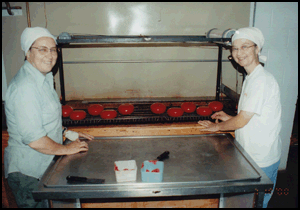
Sisters Kay Kettenhofen and Sister Barbara Smickle, cousins and Trappistines in Crozet, Virginia
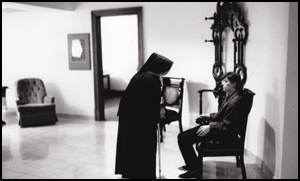
A Basilian Nun in Philadelphia, Pennsylvania
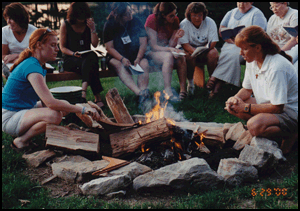
Sisters of St. Benedictine Sisters in Ferdinand, Indiana

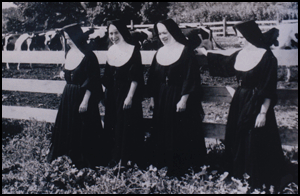
Trappistines in Crozet, Virginia
McDonald sisters of the Sisters of St. Joseph in St. Paul, Minnesota (photo by K.J. McDonald)
Q: Why is the publisher putting out a new edition, with a new cover?
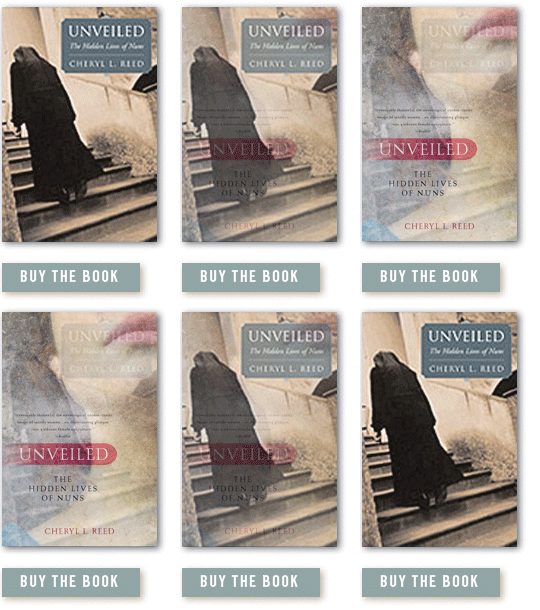
A: Since the book originally came out in 2004, it has steadily attracted attention from multiple audiences, particularly young women who are fascinated by this subculture and women who are considering becoming a sister or a nun. In some religious orders, the book is required reading for all entrants. The original cover engaged the mystique and secrecy surrounding nuns, while the new cover addresses the modern approach I took in the book, which included asking sisters and nuns about their sexuality. The book is still the largest and most in-depth look at current Catholic nuns across the country and how they have transitioned or not into the modern age.

Q: Why did you write this book?
A: I felt I had stumbled onto an incredible subculture of women who were at great risk of becoming extinct. Many orders have closed and the majority of nuns are over 70 years old. I wanted to preserve their stories but also shatter the myths perpetuated about nuns. Since I had such an unprecedented experience of meeting and interviewing so many nuns, I felt compelled to share those discoveries with others. In addition, most of the books written about nuns are academic studies or religious texts. None observe the sisters as intimately or as close-up as Unveiled does.
Q: Who should read this book and why?
A: This is a book about a choice, an option that most women today never even consider. For many women in this book, this was the only choice that would provide them an education and a career beyond raising multiple children and keeping house and perhaps living a life with a demanding husband. This book is also an exploration about whether the sisterhood is still a viable option for modern women. It's an unveiling of what it is like to live in an all-female community. This books appeals to people who are curious about other cultures -- including Protestants who always wanted to know what nuns were really like. Because there are so many feminist nuns and the book features female communities, I've had a strong following among feminists. The book also resonates with Catholics, male or female, especially those who were taught by nuns. Women interested in spirituality also seem to like the book as well as those who are interested in women's history.
Q: What were your biggest challenges in researching and reporting this book?
A: Initially my biggest challenge was obtaining access to sisters. Many nuns – even progressive sisters – live secluded lives and are suspicious of outsiders. At first, the nuns were reluctant to portray anything other than the church-lady aspect of their lives. I practice what is called “immersion journalism,” meaning that I try to immerse myself as much as possible into my subjects’ lives. In this case, I lived and prayed with the nuns and performed many of their ministries to understand them, to learn the culture so as to write about it from the inside out. When the nuns could see that I was so serious that I would adopt their lifestyle -– if only for a few days -- they began to open up about what it was truly like to have devoted themselves so intently. They were honest about what this life had required of them and what their devotion had cost them in human terms. They were candid about their trials, their personal sagas. Often, they simply forgot that I was there or began treating me as if I were one of their own. I spent hours listening to women who so rarely had attracted that kind of attention. Soon, sisters were referring me to other orders and I quickly had more invitations than I had time to accept.
Q: Did your own religious upbringing help or hinder the reporting?
A: I was raised fundamentalist Protestant. I come from a devoutly religious family – people who intently believe the Bible and quote it book, chapter and verse. I attended religious schools where I was trained extensively in Biblical knowledge. As an adult I had attended Catholic churches and then later converted to Eastern Orthodoxy. So I had an extensive background in various aspects of Christianity and was confident enough to ask penetrating questions. Also, since I wasn’t raised Catholic, I didn’t posit nuns on pedestals the way my Catholic friends do. So I was able to treat the nuns as regular folks, something they seemed to like.
Q: What can we learn from these women?
A: One of the aspects that I have learned is that religious women are not the meek, subservient, unquestioning people that we think they are. They have much to teach us about spirituality that doesn’t incorporate all the hierarchical male aspects of the Catholic Church. They would be the first ones to say that a spiritual woman doesn’t have to be a nun in order to incorporate her spirituality or their humanity with their work.
Q: There seems to be a growing interest in religion and spirituality. Why?
A: One thought is that Baby Boomers who had long dismissed the importance of religion are now fixated on their own demise. Is there an afterlife? I think we are inundated with horrible tragedies and untimely deaths just by reading or watching the news. We can see that life is fragile and we are desperate to find out what it all means. This, by the way, is what the women who are entering the sisterhood today are saying. But beyond that, I think the pedophilia crisis in the Catholic Church has caused many to question the validity of a Church that keeps secrets. We want to know what goes on beyond the closed doors that only religious are supposed to inhabit. We want to learn what religious people do and what they think and we are now willing to openly question whether some of these aging institutions and traditions should be allowed to continue as they have for centuries.